



 Religious Route: Walking Toward Easter with Mary
The tour is an invitation to experience Holy Week from the beginning of Lent, visiting sacred and symbolic places in Bogotá that connect us with tradition, faith, and culture.
This route isn't just a journey through temples, shrines, and historic roads; it's an inner experience, a mindful walk that prepares us for Easter, reminding us that faith is also lived with our feet, our memory, and our open soul. The route pays special tribute to Our Lady of Sorrows, the central figure of this liturgical season.
Description
This route isn't just a journey through temples, shrines, and historic roads; it's an inner experience, a mindful walk that prepares us for Easter, reminding us that faith is also lived with our feet, our memory, and our open soul. The route pays special tribute to Our Lady of Sorrows, the central figure of this liturgical season.
What will you see?
The main churches included in this route are described below:
❖Parroquia Nuestra Señora de los Dolores (Our Lady of Sorrows Parish)
📍 Carrera 13 # 3-37
🔹 Description:
We begin the route at this parish located in downtown Bogotá, in the Santa Fe district, in the San Bernardo neighborhood.
To venerate and give thanks to the Blessed Virgin Mary, Mother of God and Mother of the Church, a chapel was first chosen under the title of Our Lady of Sorrows (Nuestra Señora de los Dolores). It was completely burned down on April 9, 1948. The feast of Our Lady of Sorrows is celebrated on September 15, the day after the Exaltation of the Holy Cross. At the foot of the Cross, where a sword of sorrow pierced Mary’s heart, Jesus entrusted His Mother to us as our own Mother shortly before His death.
❖ Santuario Nuestra Señora de la Peña Peña (Our Lady of the Rock Sanctuary)
📍 Calle 8 # 1-21 Este
📅Construction: 17th Century
🎨 Architectural Style: Colonial
🔹 Description:
Located in the Eastern Hills of Bogotá, this sanctuary is one of the oldest temples in the city, with a strong tradition of devotion to the Virgin Mary.
🔹Historical and artistic significance:
Its image of the Virgin of the Rock (Virgen de la Peña), carved in stone, has been venerated for centuries. The original construction was commissioned by the then president of the Royal Audience in the 17th century.
🔹 Significance in the Catholic faith:
For generations, the Virgin of the Rock has been regarded as a protector of travelers and the sick.
❖ Iglesia de San Agustín (Church of St. Augustine)
📍 Carrera 7a # 6c-25.
🔹Description:
We continue to this church, known for its impressive Baroque architecture. St. Augustine has a strong religious tradition and is one of the most visited churches by the faithful in Bogotá.
🔹 Historical Significance:
The temple was built between 1642 and 1668 in colonial style as part of the former convent of the Order of Saint Augustine. This church has witnessed several historical events of great importance to the country. The body of the heroine Policarpa Salavarrieta, executed on November 14, 1817, in Bolívar Square—then known as Plaza Mayor—was buried in this temple at the request of the priests, who exhumed her remains from La Veracruz Church, where she had initially been laid to rest in a common grave. The so-called Battle of Saint Augustine also took place here, between troops loyal to then President Mariano Ospina Rodríguez and those of General Tomás Cipriano de Mosquera, who sought to overthrow him. As a result of this episode, which occurred in February 1862, the church was damaged in its southern sector and lost a significant portion of its decoration and documentary archive.
❖ Santuario Nacional Nuestra Señora del Carmen (Our Lady of Mount Carmel National Shrine)
📍 Carrera 5 # 8-36.
🔹Description:
We continue with this temple, which stands out for its Baroque facade and its proximity to the La Candelaria market. It is one of the most iconic places of worship in the city, renowned for its serene atmosphere and rich history.
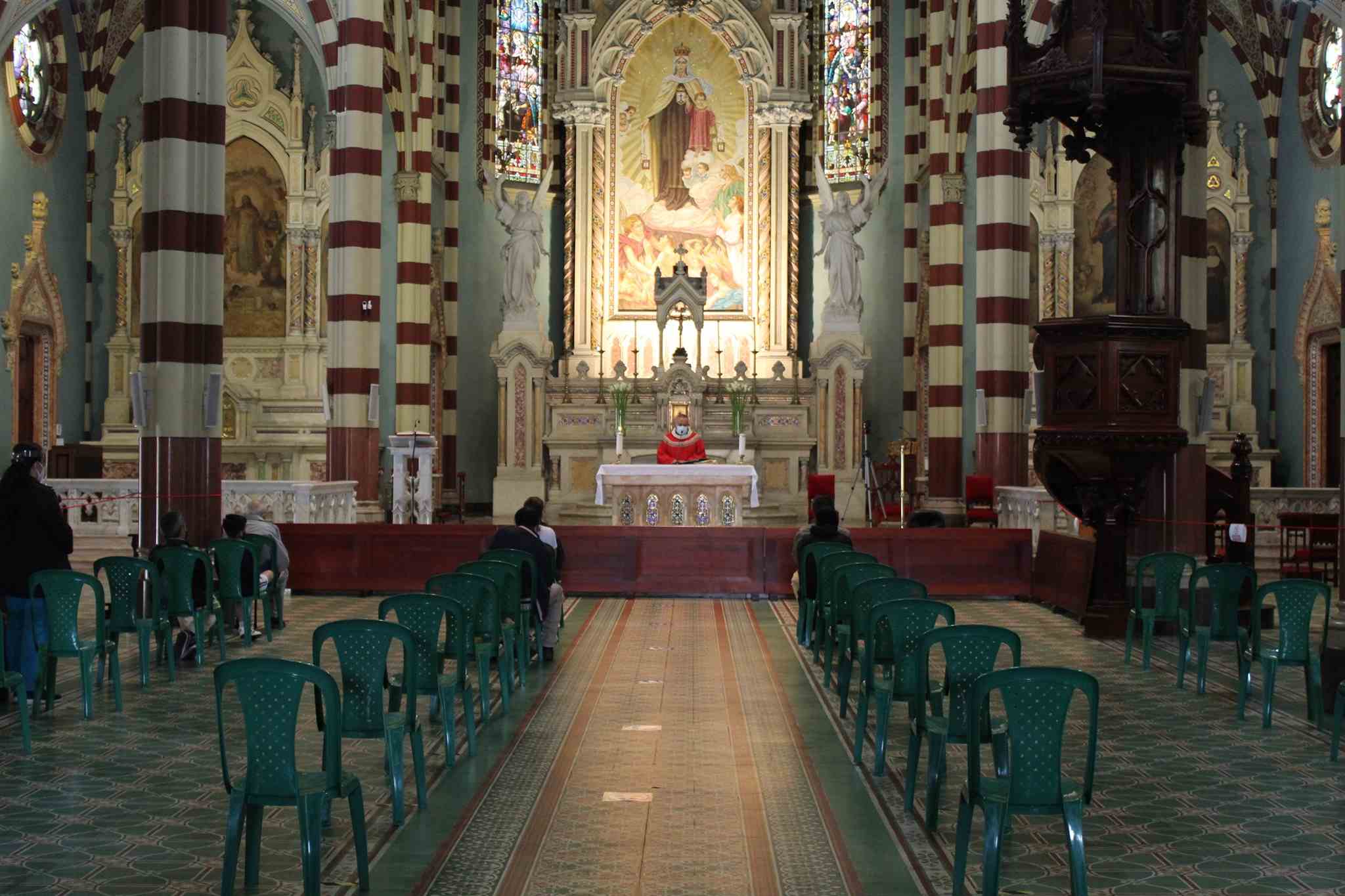
The Shrine of Our Lady of Mount Carmel rises near the Primatial Cathedral and Bolívar Square. Although the current structure dates back to 1938, its origins date back to the mid-17th century with the original small Iglesia del Carmen, once part of the Saint Joseph Monastery. Following the expulsion of the Discalced Carmelite Nuns in 1881 and its brief use as a military hospital, the government reclaimed the monastery and granted it to the Salesians in 1890. They enriched the temple with sacred art and altars dedicated to the Virgin of Carmel. Such was the devotion that it became necessary to build a new temple. Italian architect Giovanni Buscaglione designed it in an exquisite Florentine Gothic style, featuring Byzantine and Moorish details. It was restored in 1987, recovering the mural painting and frescoes at the entrance, enhancing its timeless beauty.
❖ Parroquia Catedral Primada de Colombia (Primatial Cathedral of Colombia)
📍 Cra 6 #10-65.
📅 Construction: 1807 - 1823
🎨Architectural Style: Neoclassical.
🔹 Description:
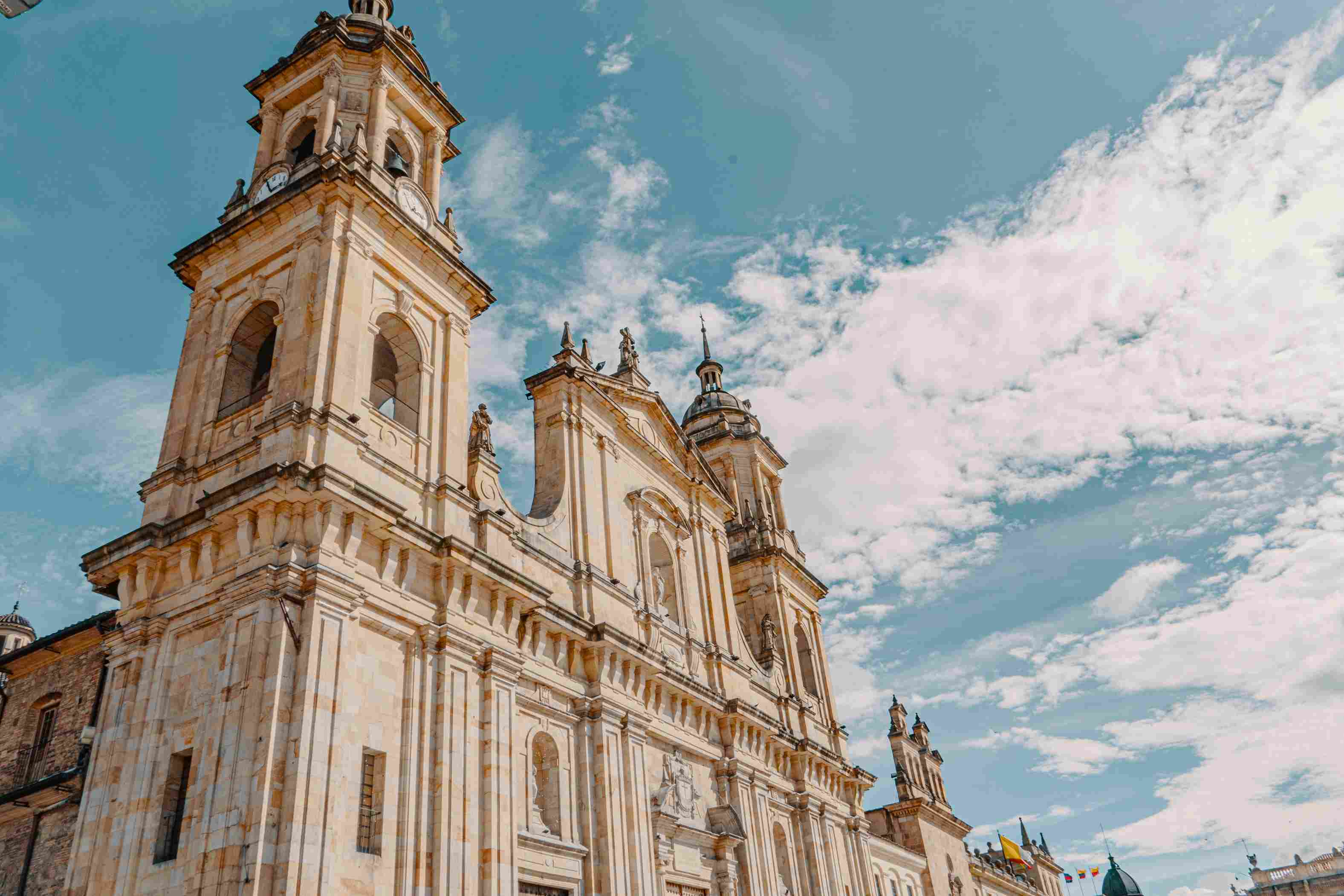
We arrive at the jewel of the tour, the Primatial Cathedral, one of the largest and most emblematic temples in Colombia. Located in Bolívar Square, its neoclassical architecture and history make it the spiritual heart of Bogotá.
🔹 Historical and artistic significance:
It is the fourth church built on this site since Bogotá was founded in 1538. It houses the remains of Gonzalo Jiménez de Quesada, founder of the city. Its main altar holds important works of sacred art, while its spacious side naves preserve valuable colonial paintings and religious sculptures.
🔹Significance in the Catholic faith:
A meeting point for major national liturgical celebrations. It represents the spiritual heart of the country, where transcendental religious events have taken place.
❖ Iglesia de San Ignacio de Loyola (Church of Saint Ignatius of Loyola)
📍 Calle 10 # 6-27.
📅Construction: 17th Century
🎨Architectural style: Baroque
🔹Description:
This temple, which stands out for its impressive facade and interior full of ornamental details, was founded by the Society of Jesus and dedicated to Saint Ignatius of Loyola.
🔹 Historical and artistic significance:
The architect and Jesuit priest Juan Bautista Coluccini was tasked with designing its construction, inspired by the Church of the Gesù in Rome. Like its inspiration, this temple features a wide central nave with side chapels, a transept, a continuous balcony, and a dome. Its style has also been linked to the Renaissance-style Basilica of Saint Andrew in Mantua, Italy.
❖ Iglesia de Nuestra Señora de la Candelaria (Church of Our Lady of La Candelaria)
📍 Carrera 4 con calle 11.
📅Construction: 17th Century
🎨Architectural style: Colonial
🔹Description:
It is renowned for its colonial architecture and its deep connection to the Virgin of La Candelaria, patron saint of Bogotá. Located in the neighborhood of the same name, it is one of the city’s most significant landmarks.
This colonial-era temple was originally part of the former Saint Nicholas of the Augustinian Recollects monastery, which for many years also housed the Saint Nicholas Augustinian School. The building features three naves, a main central nave and two side aisles, and is distinguished by two prominent towers on its front facade.
🔹Historical and artistic significance:
Famous for its colonial architecture, it stands out for its ceiling in the central nave, which has been completely restored by the La Candelaria Corporation. Inside, there are several paintings of religious scenes by the painter Pedro Alcántara Quijano.
❖ Iglesia de San Francisco (Church of St. Francis)
📍 Avenida Jiménez # 7-10.
📅Construction: 16th Century
🎨Architectural style: Colonial
🔹 Description:
We move on to one of the oldest churches in Bogotá. Saint Francis is an excellent example of colonial architectural style. Its construction dates back to the early 17th century, and it is known for its impressive main altar and the beauty of its interior.
It is located in the Veracruz neighborhood, on Avenida Jiménez and Carrera Séptima, where it forms part of a complex that also includes the Church of La Tercera and the Church of La Veracruz.
🔹 Historical and artistic significance:
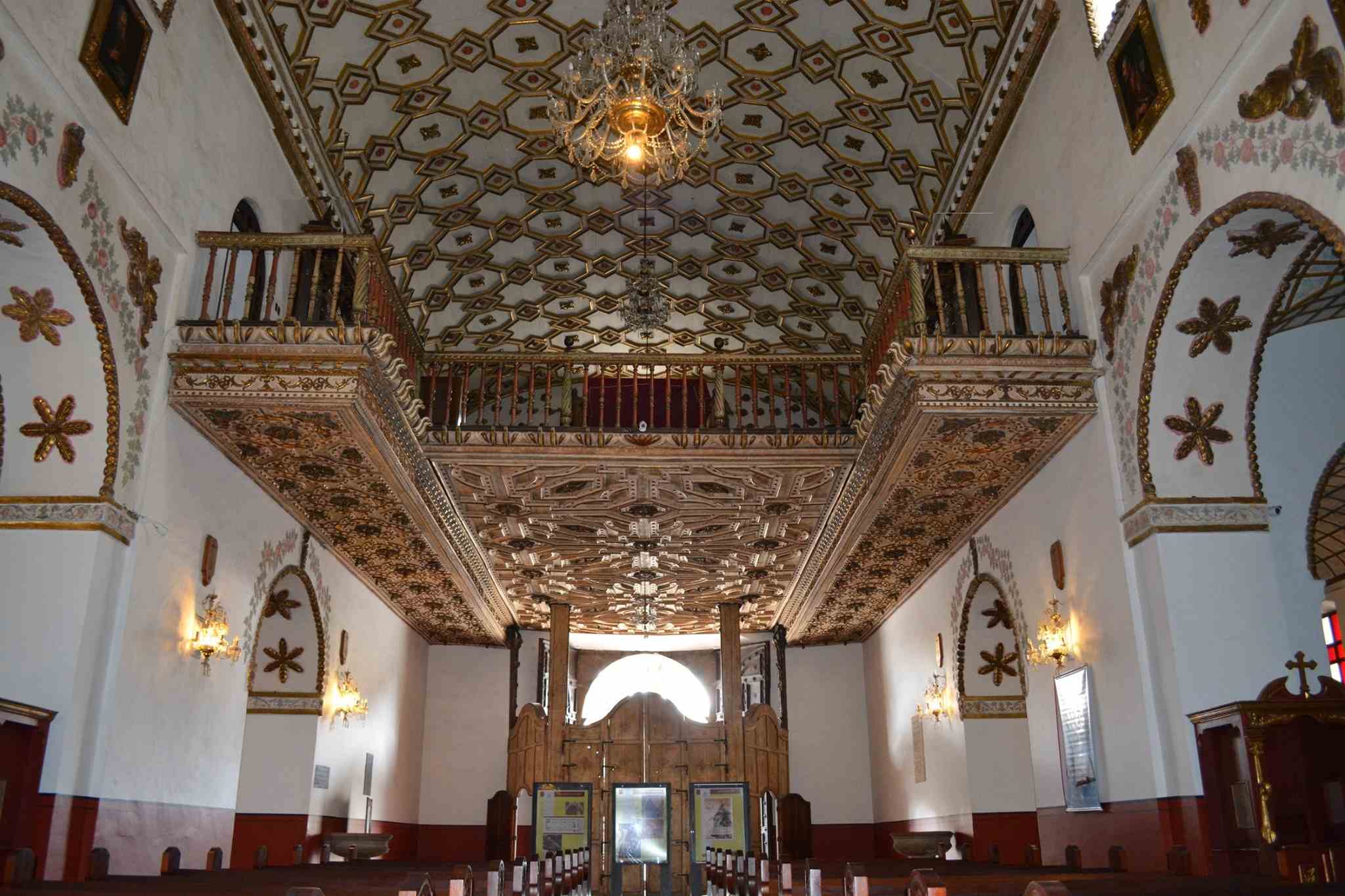
This building has one of the finest Mudejar wooden ceilings in New Granada. The altarpiece, which incorporates Renaissance elements, is the most representative of the Viceroyalty of New Granada. It is known for its monumental main altar and the beauty of its interior.
The Camarín de la Virgen Apocalíptica (Chapel of the Apocalyptic Virgin) stands out, decorated with mirrors, porcelain, cornucopias, and large paintings. The images of Christ are particularly moving, such as the Fallen Christ by Lugo de Albarracín and the Dead Christ by Martínez Montañez.
❖ Parroquia de La Veracruz (La Veracruz Parish)
📍 Calle 16 # 7-19.
🔹 Description:
We continue to this church, located in the historic center, at another important point on the route. With its sober and elegant facade, Veracruz is a place of great religious significance in the city.
🔹 Historical Significance:
During the period known as the Reign of Terror (between June and November 1816), the church became infamous. Around 80 heroes of the Independence movement were buried here in a mass grave, executed by Spanish troops under the command of Pablo Morillo. Among them were figures such as Antonio Villavicencio, Francisco José de Caldas, José Ramón Leiva, José María Carbonell, Emigdio Benítez, Joaquín Camacho, Crisanto Valenzuela, Jorge Tadeo Lozano, Francisco Antonio Ulloa, José Miguel Montalvo, and Miguel Buch.
❖ Parroquia Nuestra Señora de Las Aguas (Our Lady of Waters Parish)
📍 Cra. 2a #18A-68.
🔹 Description:
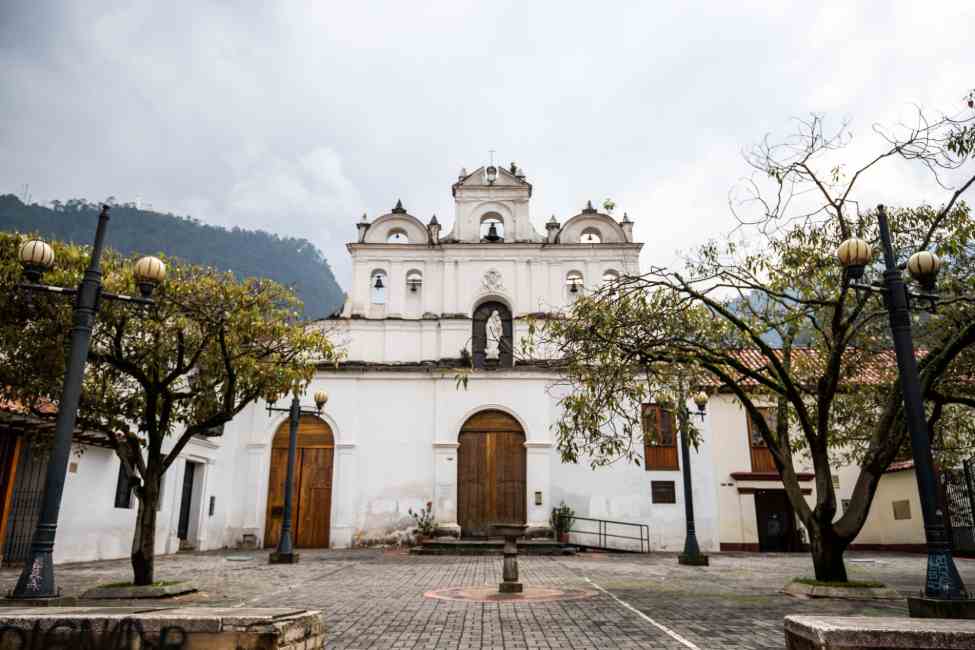
The route continues at this church, located in the Las Aguas neighborhood. It stands out for its simple architecture and peaceful atmosphere, making it a place for reflection for all visitors.
The temple is a simple colonial building, constructed between 1657 and 1694. It featured a rectangular floor plan with a single nave and a chapel dedicated to Saint Anthony on its north side, which was built in 1901.
❖ Iglesia Nuestra Señora de las Nieves (Church of Our Lady of the Snows)
📍 Carrera 7 Calle 20.
🔹 Description:
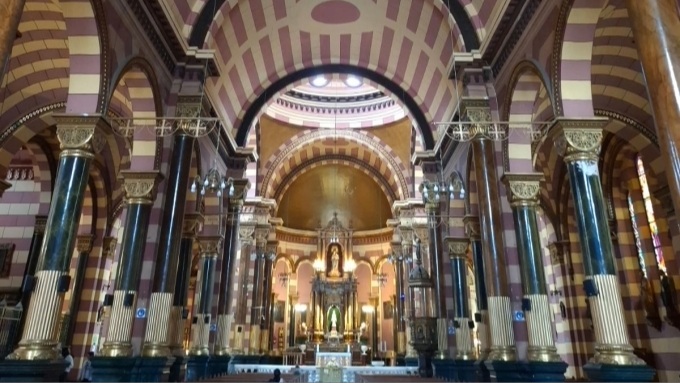
We conclude our tour at this temple located in Las Nieves Square. This Baroque church is famous for its imposing facade and an interior adorned with artistic details that represent Catholic devotion during the colonial era.
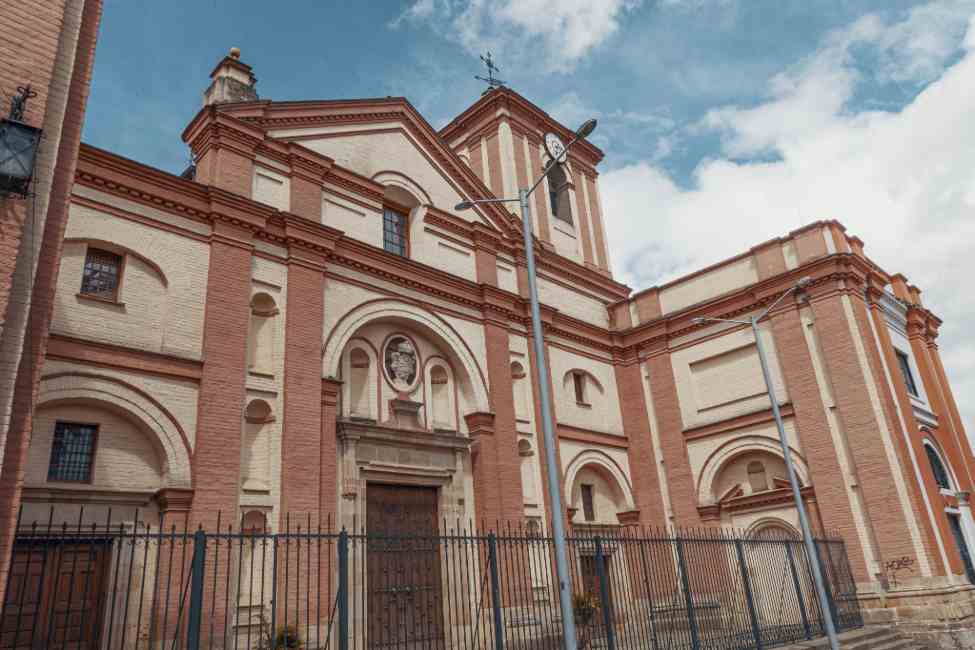
Its facade shows Byzantine influence in its towers, geometric motifs, and alternating yellow and red stripes.
* This route is ideal for those interested in Bogotá's religious heritage. It offers not only a deep spiritual connection but also a unique opportunity to admire the art and architecture of centuries past.
We recommend visiting these sites on foot, as they are relatively close to each other in the historic center of the city. Here, you can enjoy the vibrant atmosphere of Bogotá!
Encuentra más información de planes y destinos en www.visitbogota.co Descarga la app gratuita (Visit Bogotá) en tu teléfono celular y chatea con ‘Candelaria’: tu amiga virtual.
How to get there?
- By Private Vehicle: From any point in Bogotá, head towards the Historic Center in the La Candelaria district. Once there, follow the signs to the Las Aguas Church, located at Carrera 2 #18A-68.
- By Transmilenio: From Avenida Caracas, get off at the Calle 19 Station. Then, take an SITP bus heading east to Carrera 3. From that point, it’s a five-minute walk south to Calle 18A, then head two minutes uphill (east) to Carrera 2.
Do you want to go?
All the experiences featured in this route are located within the La Candelaria district.
The route is available every day, and you can set the pace and duration that works best for you.
